Tesla VIN Decoder — The Complete Guide for EV Owners Worldwide
Everything you need to know about reading, decoding, verifying and trusting a Tesla Vehicle Identification Number — for Model S, Model 3, Model X, Model Y, Cybertruck, Semi and Roadster. This guide is written for buyers, sellers, dealers, insurers and EV enthusiasts who want a single, reliable reference for Tesla VIN decoding.
1. What Is a Tesla VIN and Why Every Tesla Owner Should Know It
A Vehicle Identification Number — universally shortened to VIN — is a unique 17-character alphanumeric code assigned to every motor vehicle at the moment it rolls off the assembly line. Think of it as the vehicle's fingerprint: no two VINs in the world are the same, and once a VIN is assigned to a chassis, it stays with that vehicle for life. In the United States, the VIN is regulated by the National Highway Traffic Safety Administration (NHTSA) and standardised by the international ISO 3779 specification.
For Tesla owners — whether you drive a Model S, Model 3, Model X, Model Y, Cybertruck, Semi or Roadster — the VIN is the single most important identifier used by the DMV, insurance companies, banks, police and NHTSA through the global vehicle registration network.
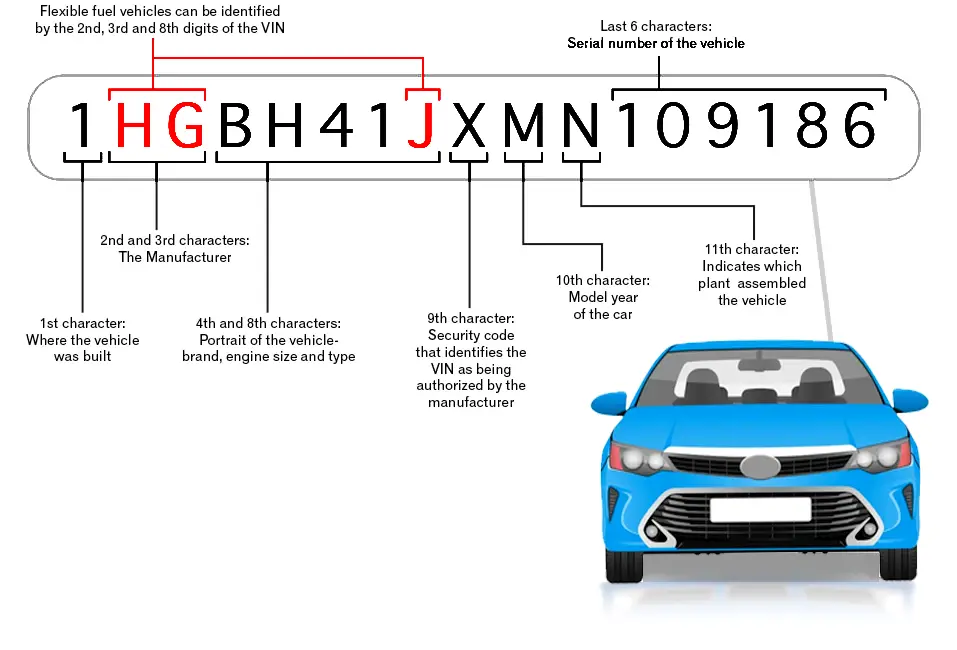
A Tesla VIN is not a random string. Every character carries meaning. The first three characters tell you the country and manufacturer, the middle section encodes the model line, body style, restraint system, battery type and drive unit, and the last eight characters encode the model year, plant code and sequential production number. Once you understand this structure, you can verify any Tesla in under 60 seconds — without paying a single rupee or dollar.
2. Anatomy of a Tesla VIN — Character-by-Character Breakdown
Every modern Tesla VIN follows the same 17-character ISO 3779 structure. Here is the position-by-position breakdown, using a typical Tesla Model 3 VIN as an example.
| Position | Section | Meaning | Tesla Example |
|---|---|---|---|
| 1–3 | WMI | World Manufacturer Identifier — country + maker | 5YJ = Tesla, USA |
| 4 | VDS | Model line | S / 3 / X / Y / C (Cybertruck) |
| 5 | VDS | Body style / chassis | Varies by model |
| 6 | VDS | Restraint system | Airbags, seat belts |
| 7 | VDS | Battery type / pack capacity | E = Standard, F = Long Range, etc. |
| 8 | VDS | Motor / drive unit configuration | Single or Dual Motor, AWD |
| 9 | Check | Check digit that validates the VIN | 0–9 or X |
| 10 | VIS | Model year | See year table below |
| 11 | VIS | Assembly plant code | F = Fremont, A = Austin, etc. |
| 12–17 | VIS | Sequential production number | Unique to that vehicle |
The Three Sections Explained
World Manufacturer Identifier (WMI — characters 1–3): The first three
characters tell you where the vehicle was built and by whom. Tesla uses multiple WMIs
including 5YJ and 7SA (Fremont, California),
7G2 (Gigafactory Texas), LRW (Gigafactory Shanghai) and
XP7 (Gigafactory Berlin-Brandenburg). If a Tesla shows a WMI that is not in
this list, either the VIN has been re-stamped illegally, or the vehicle was built under a
special arrangement.
Vehicle Descriptor Section (VDS — characters 4–9): This is the most manufacturer-specific part of the VIN. Tesla uses these six characters to encode the model line (S, 3, X, Y, C), body style, restraint system, battery pack type (Standard Range, Long Range, Performance, Plaid) and drive unit configuration (single motor, dual motor or tri-motor). The 9th character is a mathematical check digit that validates the entire VIN; if a single character is altered, the check digit will fail.
Vehicle Identifier Section (VIS — characters 10–17): The 10th character is the model year — the single most important character for used-vehicle buyers. The 11th character is the plant code. Characters 12–17 are the sequential production serial number. Because Tesla produces over 1.8 million vehicles per year across multiple Gigafactories, this number can go well above 500,000.
3. Tesla Model Year Codes — How to Read the 10th Character
The 10th character of a Tesla VIN tells you the model year. This is not always the same as the year of registration. A car built in December 2024 may be registered in January 2025 — meaning the VIN shows a 2024 model year, but the registration shows a 2025 date. Always use the VIN's 10th character as the authoritative model year.
| Code | Model Year | Code | Model Year |
|---|---|---|---|
| L | 2020 | M | 2021 |
| N | 2022 | P | 2023 |
| R | 2024 | S | 2025 |
| T | 2026 | V | 2027 |
| W | 2028 | X | 2029 |
| Y | 2030 | 1 | 2031 |
Letters I, O, Q and U are never used
in a VIN to avoid confusion with the digits 1 and 0. If you see them in a "VIN", the
number is either fake or written incorrectly.
4. Where to Find the VIN on a Tesla
Depending on the model, the VIN on a Tesla can be found in one or more of the following locations. Before you buy any used Tesla, physically match the VIN in at least three of these locations.
4.1 Tesla Model S, 3, X, Y
- Windshield lower corner (driver's side): Visible through the glass — the easiest way to read a Tesla VIN from outside.
- Driver-side door jamb: A metal or sticker plate riveted to the B-pillar carrying VIN, GVWR and tyre specs.
- Chassis stamp: Stamped into the chassis near the front-right suspension tower under the frunk.
- Frunk (front trunk) label: A printed VIN sticker inside the frunk lid.
- Registration / title: Always cross-check the VIN on the RC / title against the physical chassis.
- Tesla mobile app: The VIN is shown in the vehicle info screen inside the app.
4.2 Tesla Cybertruck
- Driver-side door jamb plate: Primary location for the Cybertruck VIN.
- Windshield lower corner: Etched on the lower-left windshield glass.
- Chassis frame (under the truck bed): Stamped into the exoskeleton frame.
4.3 Tesla Semi and Roadster
- Cab door jamb plate: For Semi, the VIN plate is riveted inside the driver-side cab door frame.
- Chassis frame rail: Stamped on the left-hand frame rail near the front axle.
- Battery pack frame: A secondary VIN plate on the high-voltage battery enclosure.
5. Tesla Model VIN Reference Table
While the VDS section (characters 4–9) is proprietary to Tesla, the following table shows typical WMI + model family combinations you will encounter when decoding Tesla vehicles worldwide.
| Model | WMI | Typical Battery | Assembly Plant |
|---|---|---|---|
| Model S (Pre-facelift) | 5YJ | 60 / 70 / 75 / 85 / 90 kWh | Fremont, CA |
| Model S (Raven / Palladium) | 5YJ | 100 kWh / Plaid tri-motor | Fremont, CA |
| Model 3 (Standard Range) | 5YJ | 50 / 55 kWh LFP | Fremont / Shanghai |
| Model 3 (Long Range) | 5YJ / LRW | 75 / 82 kWh | Fremont / Shanghai |
| Model 3 (Performance) | 5YJ / LRW | 82 kWh dual-motor | Fremont / Shanghai |
| Model X (Pre-facelift) | 5YJ | 60 / 75 / 90 / 100 kWh | Fremont, CA |
| Model X (Palladium) | 5YJ / 7SA | 100 kWh / Plaid tri-motor | Fremont, CA |
| Model Y (RWD / LR) | 7SA / LRW | 60 / 75 kWh | Fremont / Shanghai / Berlin / Austin |
| Model Y (Performance) | 7SA / 7G2 | 82 kWh dual-motor | Fremont / Austin / Berlin |
| Cybertruck (AWD) | 7G2 | 123 kWh dual-motor | Austin, TX |
| Cybertruck (Cyberbeast) | 7G2 | 123 kWh tri-motor | Austin, TX |
| Semi | 5YJ / 7G2 | 900 kWh (4× packs) | Nevada / Texas |
| Roadster (Original) | 5YJ | 53 kWh | Hethel, UK |
| Roadster (2nd Gen) | 5YJ | 200 kWh (rumoured) | California |
6. Decoding Different Tesla Models
6.1 Tesla Model S
The Model S is Tesla's flagship sedan and was the first mass-produced premium EV when it
launched in 2012. It carries the WMI 5YJ. VIN decoding reveals the exact
battery pack (60, 70, 75, 85, 90 or 100 kWh), performance variant (Standard, Performance,
P85D, P90D, P100D, Raven, Plaid) and whether the car was built before or after the
Palladium refresh. Model S VINs also encode the dual-motor or tri-motor configuration in
position 8.
6.2 Tesla Model 3
The Model 3 is Tesla's best-selling vehicle worldwide and the world's best-selling EV. Built in Fremont (5YJ) or Shanghai (LRW), its VIN decodes to reveal the battery pack (Standard Range LFP, Long Range NCA, Performance), single-motor RWD or dual-motor AWD configuration, and the specific interior trim. The 10th character tells you the model year — crucial because Tesla changes hardware mid-year (e.g., the heat pump switch in late 2020, the "Highland" refresh in late 2023).
6.3 Tesla Model X
The Model X is Tesla's falcon-wing SUV, launched in 2015. Its VIN shares the 5YJ WMI with the Model S but the VDS section differs. Decoding a Model X VIN returns the battery pack (75D, 90D, 100D, P100D, Plaid), motor configuration (dual or tri-motor) and whether the vehicle is pre- or post-Palladium refresh (2021 onwards).
6.4 Tesla Model Y
The Model Y is Tesla's best-selling SUV and is built across four Gigafactories: Fremont (7SA), Shanghai (LRW), Berlin (XP7) and Austin (7G2). Its VIN decoding is particularly interesting because it reveals not only the battery pack but also the factory — each plant has different battery suppliers, structural pack designs and even different paint formulations. For used-EV buyers, this is critical information because Austin-built Model Ys use Tesla's structural battery pack, while Fremont Model Ys (older builds) use a traditional pack.
6.5 Tesla Cybertruck
The Cybertruck launched in November 2023 and is built exclusively at Gigafactory Texas
(WMI 7G2). VIN decoding reveals the exact configuration: RWD (single-motor,
late 2025+), AWD (dual-motor) or Cyberbeast (tri-motor). It also confirms the 123 kWh
battery pack, 800V architecture and whether the vehicle is equipped with the optional
range extender.
6.6 Tesla Semi and Roadster
The Tesla Semi is a Class 8 electric truck built at Gigafactory Nevada and (later) Texas. VIN decoding returns the multi-pack battery configuration (four 225 kWh packs = 900 kWh total) and confirms the tri-motor drive unit. The original Roadster (2008–2012) carries a 5YJ WMI even though it was assembled in the UK by Lotus, giving it a unique place in Tesla VIN decoding.
7. Why a Tesla VIN Check Is Essential for Used-EV Buyers
The global used-EV market is growing exponentially. Over 2 million used Teslas have changed hands since 2020, and a growing percentage are private-party sales — without dealer warranty and often without a proper inspection. A Tesla VIN check is the single cheapest protection you can buy against:
- Stolen vehicles: A VIN check against international databases (NHTSA, Interpol, NICB) reveals if a vehicle is reported stolen.
- Salvage / write-off vehicles: Many Teslas are declared total losses after accidents and re-titled in a different state or country. VIN records expose this.
- Battery pack mismatches: Some sellers swap battery packs between cars. The VIN tells you the original pack, so you can verify.
- Odometer tampering: Less common in Teslas than ICE cars, but possible. The VIN-linked service history exposes discrepancies.
- Outstanding finance / liens: If a bank or lender has a lien on the vehicle, the VIN-linked records show it. Buying such a vehicle without clearing the loan is legally risky.
- Fake registration: Cross-check the VIN on the title against the physical chassis. If they don't match, walk away.
- Cloned vehicles: Criminals clone a VIN from a legitimate Tesla onto a stolen chassis. A proper VIN decode exposes inconsistencies in the plant code, model year or battery type.
- Flood / fire-damaged vehicles: Insurers report these against the VIN. Decoding reveals if the vehicle was written off in a disaster.
- Recall status: Tesla issues frequent over-the-air (OTA) software recalls and occasional physical recalls. The VIN tells you whether the recall work is completed.
- Hardware version: Early Model 3s came with HW2.5; later ones with HW3.0 or HW4.0. The VIN-linked build record reveals which autopilot hardware your car has.
- Decode the VIN on this page.
- Check the official Tesla service history and Supercharger access status.
- Ask for the original title, insurance and service records.
- Physically match the VIN on the windshield, door jamb, chassis and title.
- Get a third-party pre-purchase inspection focused on the battery pack and drive unit.
8. Tesla, Inc. — The Company That Changed the Auto Industry
Tesla, Inc. is an American multinational automotive and clean-energy company headquartered in Austin, Texas. Founded in 2003 by Martin Eberhard and Marc Tarpenning, and later led by Elon Musk, Tesla has grown from a niche electric-sports-car startup into the world's most valuable automaker by market capitalisation and the global leader in electric vehicles.
Tesla's mission — "to accelerate the world's transition to sustainable energy" — has driven the company to vertically integrate almost every part of its supply chain, from battery cell manufacturing to software development, charging infrastructure and direct-to-consumer sales.
Tesla operates manufacturing facilities (Gigafactories) in:
- Fremont, California (USA): Model S, Model 3, Model X, Model Y
- Gigafactory Texas, Austin (USA): Model Y, Cybertruck
- Gigafactory Nevada, Sparks (USA): Battery cells, Semi, energy products
- Gigafactory Berlin-Brandenburg (Germany): Model Y
- Gigafactory Shanghai (China): Model 3, Model Y
- Gigafactory Mexico (Nuevo León): Under construction — future models
Globally, Tesla has delivered over 6 million vehicles since the original Roadster launched in 2008. The company's Supercharger network spans 60,000+ stalls across four continents and remains the industry benchmark for charging speed and reliability. Tesla Energy also manufactures Powerwall, Powerpack, Megapack and Solar Roof products, extending the company's impact far beyond automobiles.
9. VIN Decoding for Insurance and Finance
Every motor insurance policy is linked to a vehicle's VIN. Insurers such as State Farm, Geico, Progressive, Allstate, Tesla Insurance, Nationwide, Liberty Mutual and USAA use the VIN to confirm the make, model, variant and year of the vehicle being insured. If the VIN on your policy doesn't match the vehicle you actually drive, your claim can be rejected — even for a genuine accident.
Banks and lending institutions that finance vehicles — Chase, Wells Fargo, Bank of America, Tesla Financing, Ally Financial — record a lien against the VIN on the state title. When you decode a VIN, you can then check whether any lien exists. If it does and the seller claims the loan is closed, insist on a lien release before paying.
In countries outside the US, equivalent systems apply: DVLA (UK), VAHAN (India), RDW (Netherlands), KBA (Germany) and similar registers. Our decoder returns the global manufacturer-level data; local registration details should always be verified through the relevant national authority.
10. Tesla Recalls, OTA Updates and VIN Lookup
The National Highway Traffic Safety Administration (NHTSA) maintains an official vehicle recall database for the US market. Tesla has issued numerous recalls over the years — some delivered via traditional physical service, and many resolved through free over-the-air (OTA) software updates.
Notable Tesla recall categories include:
- Autopilot / Full Self-Driving (FSD) software behaviour (OTA fixes)
- Battery management system firmware
- Seat belt and airbag sensor calibration
- Suspension component inspection on early Model S and Model X
- Cybertruck accelerator pedal cover (2024 physical recall)
- Model 3 and Model Y rear camera harness
- Model S and Model X touchscreen eMMC memory wear (2021)
When you decode a VIN on our site, you can then cross-check the result against the NHTSA recall list to see whether your specific Tesla is affected and whether the recall work is completed. This is especially important if you buy a used Tesla privately: an uncompleted recall can leave you with a safety-critical defect that may be expensive to fix out-of-pocket.
11. How Our Free Tesla VIN Decoder Works
Decoding a Tesla VIN on tesla.vindetails.info takes less than 10 seconds. Here's what happens step by step:
Locate the VIN
Find the 17-character VIN on your Tesla's windshield, door jamb, or title.
Enter It
Type or paste the VIN into the search box at the top of this page.
Verify
The invisible reCAPTCHA runs automatically — no clicks required.
Get Results
View manufacturer, model, model year, plant, battery and vehicle age.
All decoding is done server-side over SSL. We do not store your VIN for marketing purposes; we only keep a small recent-VIN log to display popular decodes on the homepage.
12. Frequently Asked Questions About Tesla VINs
Can I decode a Tesla Model 3 or Model Y VIN for free?
Does the VIN tell me the exact build date?
Is it legal to check a VIN?
What if the VIN has 11 or 16 characters?
How do I know the VIN is genuine?
Can I decode a Tesla Cybertruck VIN?
Does the decoder work for Tesla EVs?
How accurate is the data?
Where is the VIN located on a Tesla Model 3 or Model Y?
How much does the Tesla VIN decoder cost?
13. World Manufacturer Identifier (WMI) — Tesla Plants
The WMI is the first three characters of the VIN. Tesla uses different WMIs for each Gigafactory, and knowing them helps you instantly identify where a Tesla was built.
| WMI | Plant | Country | Models Built |
|---|---|---|---|
| 5YJ | Fremont, California | USA | Model S, 3, X, Y |
| 7SA | Fremont, California | USA | Model X, Y |
| 7G2 | Gigafactory Texas, Austin | USA | Model Y, Cybertruck |
| LRW | Gigafactory Shanghai | China | Model 3, Model Y |
| XP7 | Gigafactory Berlin-Brandenburg | Germany | Model Y |
| SFZ | Roadster (original, Hethel UK) | UK | Roadster 2008–2012 |
14. Tesla Battery and Motor VIN Decode
One of the most valuable things a Tesla VIN decode reveals is the battery pack type and drive unit configuration. This is particularly important for used-EV buyers because battery pack differences between variants are not always obvious from the outside — and they can swing resale value by $10,000 or more.
When you decode the VIN of a Tesla, the following fields are typically returned:
- Model: Model S, 3, X, Y, Cybertruck, Semi, Roadster
- Battery pack: Standard Range / Long Range / Performance / Plaid — plus the approximate kWh
- Motor: Single-motor RWD, dual-motor AWD or tri-motor Plaid / Cyberbeast
- Charging: Supercharger V2, V3 or V4 compatibility; CCS2 adapter support
- Plant: Fremont, Austin, Shanghai, Berlin or Nevada
- Model year: Position 10 of the VIN
- Autopilot hardware: HW2.5, HW3.0 or HW4.0 (via linked service record)
For EV buyers, VIN decoding is especially important because battery pack variants are not always obvious from the outside. Two Model 3s that look identical may have 55 kWh LFP and 82 kWh NCA packs respectively — and the resale value differs by thousands. The VIN is the only reliable way to confirm which battery pack your vehicle actually has.
15. VIN Glossary — Terms Every Tesla Buyer Should Know
- VIN: Vehicle Identification Number — 17-character unique code.
- WMI: World Manufacturer Identifier — first 3 characters.
- VDS: Vehicle Descriptor Section — characters 4–9.
- VIS: Vehicle Identifier Section — characters 10–17.
- Check digit: Position 9, mathematically validates the VIN.
- Model year: Position 10, the year designated by the manufacturer.
- Plant code: Position 11, where the vehicle was assembled.
- NHTSA: US National Highway Traffic Safety Administration.
- Monroney sticker: The US new-car window sticker with MSRP and options.
- OTA: Over-the-air software update, delivered wirelessly by Tesla.
- HW2.5 / HW3.0 / HW4.0: Tesla Autopilot / FSD computer hardware generations.
- LFP: Lithium Iron Phosphate battery chemistry — used in Standard Range Teslas.
- NCA: Nickel Cobalt Aluminium battery chemistry — used in Long Range Teslas.
- Supercharger: Tesla's proprietary DC fast-charging network.
- Salvage title: A title issued after a vehicle is declared a total loss.
- Lien: A legal claim on a vehicle by a lender until the loan is paid off.
16. Cross-Checking a Tesla VIN with Official Databases
Our decoder gives you manufacturer-level details from the global VIN registry. For region-specific data — registration, title status, lien, recall history and service records — you should always cross-check the VIN on the relevant national database.
Combining our VIN decode with an official database check gives you a complete picture:
- Our VIN decode confirms the vehicle (manufacturer, model, model year, plant, battery type).
- NHTSA (nhtsa.gov/recalls) confirms US recall status.
- Your state DMV confirms registration, title and lien status.
- Tesla service (via the app or service centre) confirms OTA and physical recall work.
- Together they expose any mismatch — the biggest red flag in a used-EV deal.
17. Beyond VIN — Full Checks Before Buying a Used Tesla
- VIN decode: Confirm model, model year, plant, battery type, drive unit.
- Title check: Match VIN on the title against the physical vehicle and confirm the title is clean (not salvage or rebuilt).
- Lien check: Confirm no outstanding loan exists on the vehicle.
- Recall status: Verify all NHTSA recalls have been completed.
- Service history: Ask for the Tesla service record via the app or a service centre printout.
- Battery health: Ask for a recent Tesla battery health report or run a third-party EV battery diagnostic.
- Supercharger access: Verify the car has not been flagged for salvage title (which disables Supercharger access).
- FSD / Autopilot status: Confirm whether FSD was purchased, transferred, or is a subscription.
- Physical inspection: Panel gaps, paint match, tyre wear, brake pads, suspension components.
- Test drive: Accelerate hard, test regen braking, listen for drive unit noise, check for shudder under acceleration.
- OBD / diagnostic port: A Tesla-specific scan reveals hidden HV battery and drive unit errors.
- Chassis match: Ensure the VIN on the windshield, door jamb, chassis and title all match.
18. Why Use Tesla.VINDetails.info?
- 100% free: No signup, no credit card, no hidden fees.
- Tesla-focused: Tuned specifically for Tesla VIN formats and WMI codes.
- Multi-model support: Model S, 3, X, Y, Cybertruck, Semi and Roadster.
- Instant results: Server-side decoding in under 2 seconds.
- Battery-aware: Returns battery pack type, drive unit configuration and plant of assembly.
- Mobile-friendly: Works on any phone, tablet or desktop.
- Secure: All traffic served over HTTPS with invisible reCAPTCHA.
- Clean shareable links: Every VIN decode gets a permanent URL.
- Global coverage: Decodes Teslas built in the USA, China, Germany and the UK.
19. Final Thoughts — Decode Before You Decide
Whether you're buying your first Tesla Model 3, verifying a used Model Y before a $30,000 deal, or managing a fleet of Tesla Semis, the VIN is the single most powerful tool you have. It takes 10 seconds to decode. It can save you months of paperwork, tens of thousands of dollars in hidden repairs, and the emotional cost of discovering your "clean" used EV was actually a stolen, flood-damaged or salvage-title vehicle.
Our mission at tesla.vindetails.info is simple: give every buyer, worldwide, free, instant, reliable access to the data they need to make a confident decision. No login walls. No upsells. No misleading "premium reports". Just the raw facts — manufacturer, model, model year, plant, battery, motor and country — pulled directly from the global VIN registry.
Scroll to the top, paste your Tesla VIN into the search box, and get your full decode in seconds. And if this guide helped you, share it with anyone who's about to buy a used Tesla. It might just save them from a costly mistake.